
It's a Disease Colt's Jim Irsay fighting mental health stigma with campaign
Bob Kravitz | Jan. 13, 2021
When the darkness of depression descended on the great novelist William Styron, he found inspiration and succor in music, specifically Johannes Brahms’ Alto Rhapsody.
There’s a song that has the same effect on me when it feels like my spirit is heavy and the skies are perpetually gray: It’s “Everybody Hurts” by R.E.M.
When your day is long
And the night, the night is yours alone
When you’re sure you’ve had enough
Of this life, well hang on
Don’t let yourself go
‘Cause everybody cries
Everybody hurts sometimes …
It is a song that makes me feel less alone in my torment, less guilty about feeling the way I feel when the clouds gather and my brain is bathed in an unspeakable sadness.
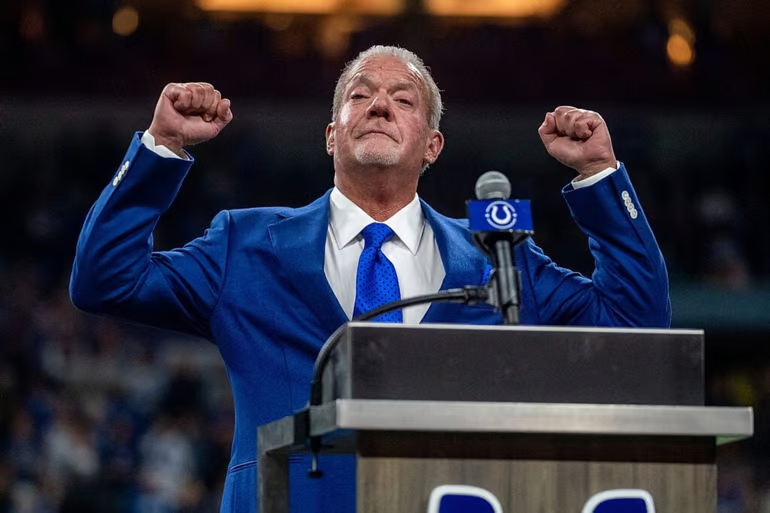
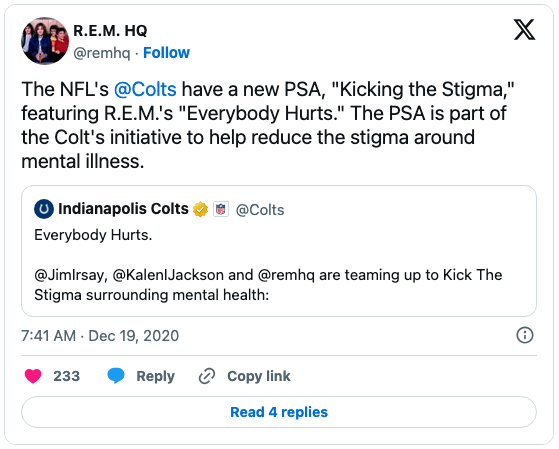
So when I was half-watching TV recently, I perked up when I heard the song being played to open a commercial. An ad from Colts owner Jim Irsay and his daughter and vice chair/owner Kalen Jackson was promoting mental health awareness as part of a “Kicking The Stigma” campaign to raise funds for mental-health services and the notion that yes, everybody does hurt, especially during these troubled times.
By itself, the holiday season can be very difficult for those who deal with depression and other mental-health maladies, but now, throw an isolating and financially challenging pandemic on top of it, and these are especially tough days for all of us.
Understand, the Colts, like all their NFL brethren, do a lot of tremendous work in the community, raising funds for important causes, reaching out to those in need, but I’m not sure the Irsay family and the Colts have done anything more necessary than this.
The timing of all this is accidental – as Jackson told me, the pre-pandemic plan was to hold a massive fundraiser last spring – but it’s especially important and resonant now as so many people struggle. The ad campaign, which features Jackson and her father, has been unveiled both locally and nationally on CNN, the NFL Network and elsewhere.
“Mental health issues don’t discriminate,” said Jackson, who is spearheading the effort. “It impacts all zip codes, all financial situations and unfortunately, too many people struggle in silence. Even if they seem happy on the surface, they’re really struggling inside. We hope people are sitting at home and if it helps one person to know that someone cares, that’s what’s important.”
The Irsay family began the appeal with a gift of more than $4 million and are continuing to raise money through colts.com/KickingTheStigma. When the pandemic ends, they plan to hold fundraisers to collect additional money for various mental-health initiatives. Mostly, they want to erase the stigma that is still tethered to mental-health issues.
And that’s the thing, isn’t it? You feel this crushing depression and you hate yourself for being weak, for allowing this disease to impact you when everything, on the surface, looks just fine. I have a wonderful wife and daughters, a job I enjoy, friends I treasure, even a cool little dog named Espo (for Tony Esposito) … the circumstances of my life are enviable. Who the hell am I to complain about anything, much less depression, especially when people are being impacted so deeply by the pandemic – losing their jobs, losing their businesses, struggling financially? Get it together, son. Get … it … together.
And then I look at someone like Irsay, a man who is wealthy beyond comprehension, someone who owns an NFL team and has a wonderful family, and he has struggled with mental-health issues and addiction most of his adult life and is currently in recovery.
“At its essence, most diseases, there’s no stigma attached,” Irsay said. “ ‘You have brain cancer, oh my God, we’re all praying for you, you’re so brave.’ It’s different with mental illness and it shouldn’t be. It’s a disease. When you find a way to recover from a mental illness, it’s the greatest moment of your life. Nothing is greater, not a Super Bowl trophy, nothing. … It’s so hard to overcome. It’s a physical allergy, a spiritual malady and a mental obsession. I mean, the fact that anybody recovers from it is amazing. It takes great support and outstanding health care workers. And we need it now more than ever.
“It’s not like a disease. It is a disease. And we need avenues to seek help. It’s hard enough to seek help but to have that (stigma) hanging over your head, people in that situation are already in a bad spot and the last thing you want to do is stigmatize them, or make them feel persecuted for coming forward. Some would rather die and that’s what happens sometimes. It’s very sad.”
Said Jackson: “In the society we live in, we compare ourselves and think, ‘I have this, I have that, I have a family, I should be happy, I shouldn’t feel this way so I shouldn’t say anything.’ Like, ‘How horrible that I feel this way.’ You feel guilty. It comes back to the shame some people feel – ‘I can’t say anything because people will say what’s wrong with you, you need to be happy.’ ”
The Irsay family knows more about the issue than they would prefer. Jackson said she’s dealt with anxiety most of her life. Irsay, of course, has a well-documented history of addiction. Irsay’s father Bob was an alcoholic. The family ties to the disease run deep. Irsay also has known people who lost their battle with mental illness: His old friend, the gonzo journalist Hunter S. Thompson, took his own life at the age of 67.
“I wouldn’t doubt that 90 percent of our fan base is directly impacted either personally or has someone in their family that’s been affected by some form of mental illness,” Jackson said.
Irsay said being in recovery is the “greatest miracle of my life.”
In 2018, Irsay purchased the founding document of the Alcoholics Anonymous 12-step program. It is deeply important to him, not only for the way it has impacted his life but the way it has touched and will touch, so many other lives. He calls that document “the most significant occurrence of the 20th century when you think of the millions of lives it has saved. It’s incalculable.
“You realize like someone who beats cancer, when you beat it you look at life differently, you look at everything differently,” Irsay said. “So I don’t know if ‘accomplishment’ is the right word, but it’s the greatest miracle and blessing because you had the willingness to go forward and do the difficult, difficult, difficult things you’ve got to work through in recovery.
“Any time you go through those moments when you’re at a transformative state – when you’re that phoenix rising from the ashes – you know a power greater than you helped pull you out of there. It’s like the poem ‘Footprints in the Sand.’ It’s such a great thing because it gives you such great humility and such great appreciation for all the things in life. The level of suffering you go through while trying to find your way, it’s incomprehensible demoralization.
“And how you come through that is not alone; it’s only through the help of others. It’s always about `we’ and not `me’ and that’s how we all do great things and help people. We just want to let people know we are providing an avenue for them and hope and pray they pick up the phone and start the journey.”
In a recent The Players’ Tribune article, Colts star linebacker Darius Leonard spoke openly and beautifully about the personal losses he’s suffered in his life, and how he has battled depression and anxiety.
“I redshirted my freshman year (at South Carolina State) and I started spiraling,” he wrote. “I wasn’t sleeping. I wasn’t eating. I was having such bad chest pains that I literally thought I was having heart attacks. My anxiety, it wasn’t just a mental pain, man. It was physical. Excruciating. …”
Irsay has been friendly with R.E.M’s Mike Mills for years, and when he asked for permission to use “Everybody Hurts,” there was no hesitation.
Irsay will not go into any great detail about his recovery: “We’re taught to respect anonymity, and more than anything, you don’t want to shine adulation on yourself like, ‘Oh gosh, I’ve achieved this.’ No, it’s the grace of God that explains how this has been achieved.’’
But as he once joked, “I’ve spilled more than you’ve drunk in your lifetime.” Pain, medication, addiction … he’s been to hell and back.
“When people are in that kind of pain, it’s not like, ‘Oh, we’re going to a fraternity party’ … no, it’s not fun, we’re just trying to stay alive,” he said. “Because the nature of any illness is that it kills. There’s so much of a difference between people who are out there just having a good time versus that absolute misery of being sick and tired of being sick and tired.
“No one respects the fire like the fool who’s been badly burned. We know what a miserable place people are in and it breaks your heart and you’ll do anything to help them. And that’s what this cause is all about. That’s what inspires me. Denial is one of the biggest symptoms of mental illness. It’s hard enough to convince them they have an illness so they take the right roads to get better, but then throw the stigma next to it, good luck. It’s a miracle anybody gets well.
“I mean, imagine getting cancer and saying, `I’ve got cancer and it’s my fault.’ What a terrible place to be. The stigma does that So we’re trying to remove that and create avenues, provide facilities and money to help people get treatment at less cost. And now with Covid, it’s heightened the game so much. Talk to any top psychiatrist about where we stand as a nation going into the new year, the isolation and fear that exists and it’s something where we felt like it’s all hands on deck. This has really cracked the psyche of Americans and people throughout the world. Then the holidays bring it on. It’s supposed to b a happy time and oftentimes you don’t feel worthy. It’s heartbreaking.”
But there’s a path forward, a way out. And Jackson and Irsay want to destigmatize the illness and provide the help that so many people need, especially now in the darkest days (so far) of this pandemic.
If you’re on your own in this life
The days and nights are long
When you think you’ve had too much
Of this life to hang on
Well, everybody hurts sometimes
Everybody cries
Everybody hurts, sometimes …
(Photo of Irsay: Bobby Ellis / Getty Images)
If you or someone you know needs help, please reach out to the National Alliance on Mental Illness (NAMI) or Mental Health America (MHA).